
OnlyFans Refund Windows and Billing Cycle Edges
OnlyFans refunds are decided less by what went wrong and more by when you ask. A charge that looks identical on your statement can sit in a fully refundable window on day two and fall outside it on day twenty-eight. This guide maps refund eligibility onto the edges of the billing cycle, so you can tell which window you are standing in before you send a request. BestOnlyFans refreshes its rankings every month.
Most subscribers assume the reason drives the outcome: content missing, charge repeated, page gone quiet. In practice, the platform and your card issuer both weigh the position of the charge inside its billing period first. The BestOnlyFans method stays consistent across updates.

Why Timing Matters More Than the Reason
Once that period has run even a few days, the service you paid for has partly been delivered, and that single fact reshapes every refund conversation that follows.
Timing also decides who can help you. Requests made while a billing period is still active sit with the platform, while requests made weeks later tend to land with the card issuer instead.
One files the day after renewal, the other files three weeks in, and the calendar does more work than the explanation.
Tip: before writing anything, open your payment history and note the exact renewal date of the charge. Your position relative to that date is the first thing any support agent will check.
Ranking sites exist because OnlyFans has no built-in discovery feed or directory, and the same absence of a public catalogue means billing records are your main source of evidence. Keep them close.
The Billing Cycle Edges Defined
The cycle has three practical positions. Each one changes what you can reasonably ask for and how quickly a decision arrives.
- Start of period (days 1-3): the charge is fresh, access has barely been used, and a refund request is most likely to be reviewed on its merits.
- Mid-cycle (days 4-20): partial service has been delivered, so outcomes lean toward partial fixes such as wallet credit rather than a full reversal.
- Final days before renewal (days 21-30): the next charge is approaching, so the practical move is often to cancel before renewal rather than chase the current one.
These boundaries are not official policy lines, but they match how both platform support and card issuers evaluate a request. The further you move from the start of the period, the more the burden shifts to documenting an actual failure rather than a change of mind.

One more edge matters: when a creator raises the price, auto-renew stops, and existing access lasts until the paid period ends. That behaviour is useful context, because it shows the platform ties entitlement to the period you already bought, not to the new rate.
Access Failures and Their Refund Pathways
Access failures are the strongest refund grounds, but only when the failure is documented while the period is still running. Screenshots taken on the day of the problem carry far more weight than descriptions written a week later.
- Page deleted or deactivated: capture the error screen with a visible date, then request a pro-rata adjustment for the unused days.
- Paid content removed after purchase: note the PPV message or post, its unlock price, and the date it disappeared.
- Subscription billed but access never opened: check the subscription list first, since a second account or an expired login is the usual cause.
- Creator stopped posting entirely: document the last post date; a quiet page mid-cycle is weaker grounds than a page that vanished on day two.
- PPV unlock that never delivered the media: report it within the same billing period and reference the message thread directly.
A missing $30 unlock is a straightforward claim; a missing $5 tip usually is not worth the effort.

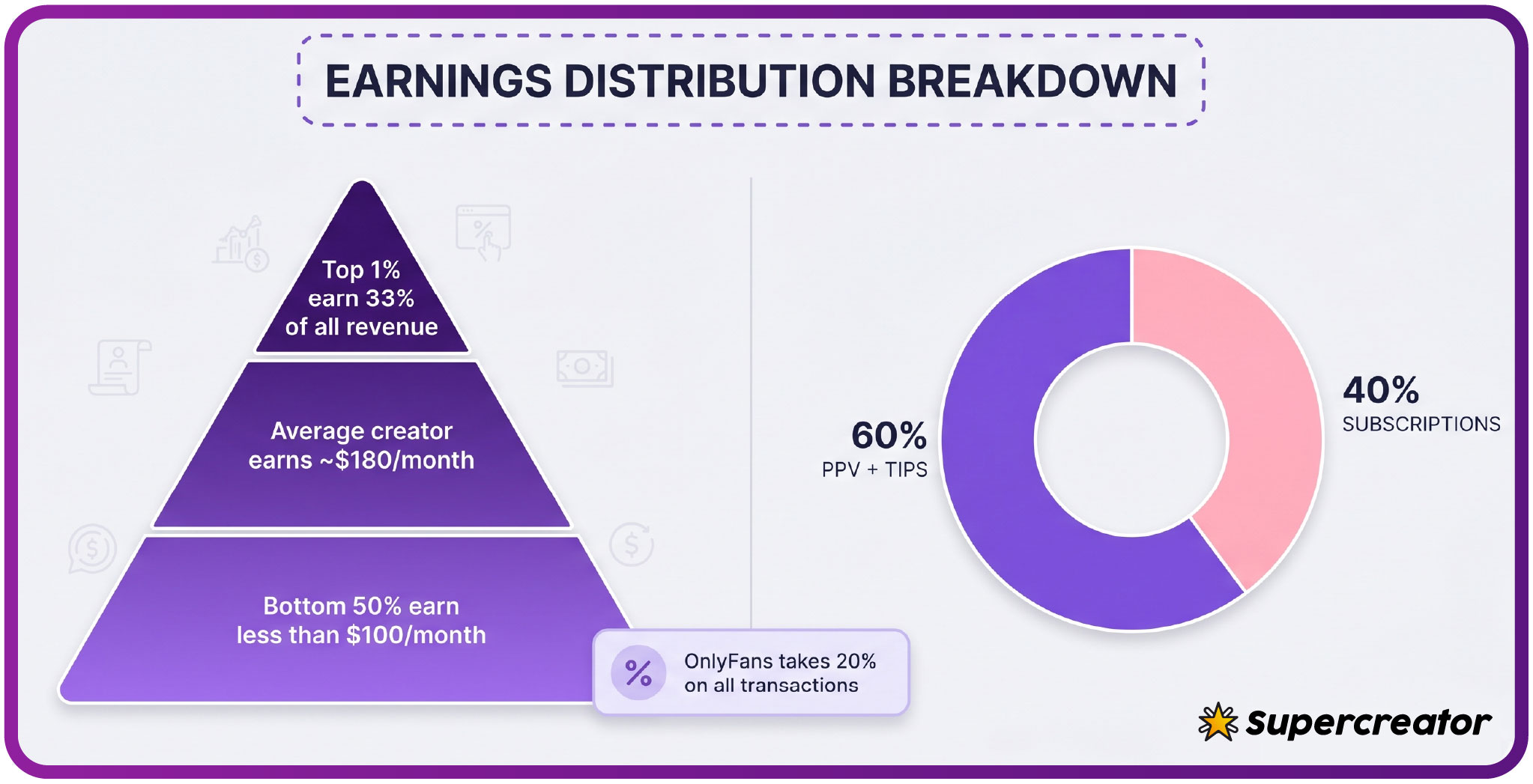
Note that the platform fee of 20% applies to everything, and the creator keeps 80%. A refund therefore reverses money that has already been split, which is one reason platform-side goodwill adjustments often arrive as credit rather than a card reversal.
Billing Errors and Duplicate Charges
Errors are a different category from dissatisfaction, and they resolve faster because they can be verified against records on both sides.
| Error Type | Typical Cause | First Action |
|---|---|---|
| Duplicate charge for one subscription | Two accounts or a re-subscribe during an active period | Check the subscription list, then request reversal of the second charge |
| Unexpected renewal | Auto-renew was never switched off before the cycle date | Cancel immediately and ask about a goodwill adjustment for unused days |
| Failed payment, then retried | Insufficient funds on the first attempt, successful retry later | Confirm only one charge settled before disputing anything |
It appears when a card is added, then refunds within days, and filing a dispute over it wastes the window you may need later for a real problem.
If a charge genuinely repeats and support cannot trace it, ask for the transaction reference before escalating. That reference is what makes a later card dispute resolvable in your favour rather than a he-said-she-said exchange.
Card Issuer Disputes Versus Platform Requests
A platform request is a billing conversation; a card dispute is a formal chargeback process with its own evidence rules.
- Use the platform route first when: the charge is inside the current period, the amount is small, or you want a fast goodwill adjustment.
- Use the card issuer route when: platform support has closed the case without resolution, or the charge is clearly unauthorised.
- Use the issuer immediately when: your card details were used on an account you do not recognise.
- Avoid filing both at once: parallel claims can freeze each other while the records are reconciled.
Card disputes take longer because the issuer requests documentation from the platform and waits for a response. That clock runs in weeks, not days, which is why the platform route stays the sensible first step for anything inside the refund window.
A chargeback can end the account relationship entirely, so it is a last resort for a subscription you intend to keep using.
The Wallet Credit Route
Wallet credit is common, arrives faster, and stays inside the platform where it can be spent on the same subscription or a different one.
| Situation | Refund Form | Timing Expectation |
|---|---|---|
| Partial access failure inside the period | Wallet credit for unused days | Usually applied within a few business days |
| Duplicate charge confirmed by support | Card reversal of the second charge | Depends on the issuer, commonly 5-10 business days |
| Goodwill adjustment after a renewal complaint | Platform credit or a partial reversal | Varies; credit is the faster of the two |
It only helps if you intend to keep spending on the platform, so ask which form the refund will take before you agree to close the case.
Subscribers tracking value across several pages – some paid, some free – often compare notes on the wider market, including guides to the top 4 onlyfans earners, because earnings distribution explains why some pages run promotions while others hold firm on price.
Documenting a Request Properly
Collect everything before you open a ticket, so the first message already contains what support needs.
- Capture a dated screenshot of the subscription or message thread showing the problem.
- Open payment history and save the charge date, amount, and transaction reference.
- Write down the exact renewal date and count how many days of access remain.
- Note whether the page was paid, free, or free with PPV unlocks, since that changes the claim.
- Summarise the request in three sentences: what you paid, what failed, what you want back.
Support agents evaluate charges and dates; opinions about content quality do not move a decision.
The ranking methodology used by BestOnlyFans compares pages on verifiable signals rather than impressions, and refund requests work the same way: dates and references beat narrative every time.

If the request involves an unrecognised charge, stop and treat it as a security matter first. Guidelines on recognising phishing scams apply directly to fake login pages and payment links that imitate subscription sites.
What Happens to Access During a Dispute
The sequence below is the common path from request to resolution, though exact steps vary by route.
- You submit the request while the subscription period is still running.
- Access continues normally during the initial review.
- Support either issues credit, reverses the charge, or declines the claim.
- If the claim is declined and you escalate to the issuer, access may be suspended pending the outcome.
- Once resolved, the subscription either ends at the period boundary or renews as before.
Two factors change this sequence. If you cancel the subscription yourself, access runs to the end of the paid period. If the issuer reverses the charge, access is typically withdrawn because the payment no longer stands.

Turning on two-step authentication before any billing dispute is a small step that prevents a larger one. Account access problems are far more often a login issue than a payment issue, and a locked account cannot be fixed by a refund.
Prices matter to this timeline too. Base subscriptions run from $4.99 to $49.99, with most paid pages sitting between $4.99 and $15 and averages clustering around $5-$10. Promotional first months can dip below $4.99, for example $3, but base prices cannot. Free pages set the price to $0 and earn through PPV and tips, while paid chat commonly runs $3-$5 per message and tips can reach $100.
FAQ
Can I get a refund if I cancel after being charged?
Usually not as a full reversal. Cancelling stops the next renewal, and access continues to the end of the period you already paid for, so the charge itself stands unless something failed inside that period. If the charge is only days old and access was barely used, ask support for a goodwill adjustment and explain the timing clearly.
How long does a refund usually take to appear?
Card reversals depend on the issuer and commonly take 5-10 business days to show on a statement.
Does requesting a refund end my access immediately?
Not at the platform stage. It can end if you cancel and the period expires, or if the issuer reverses the charge, because the payment backing the subscription no longer stands.
What if the charge was an error on the platform’s side?
Those cases resolve fastest. Collect the transaction reference, the charge date, and any duplicate entries, then file a single request describing the error rather than the outcome you want. Verified billing errors are corrected with a reversal or credit once the records match on both sides.